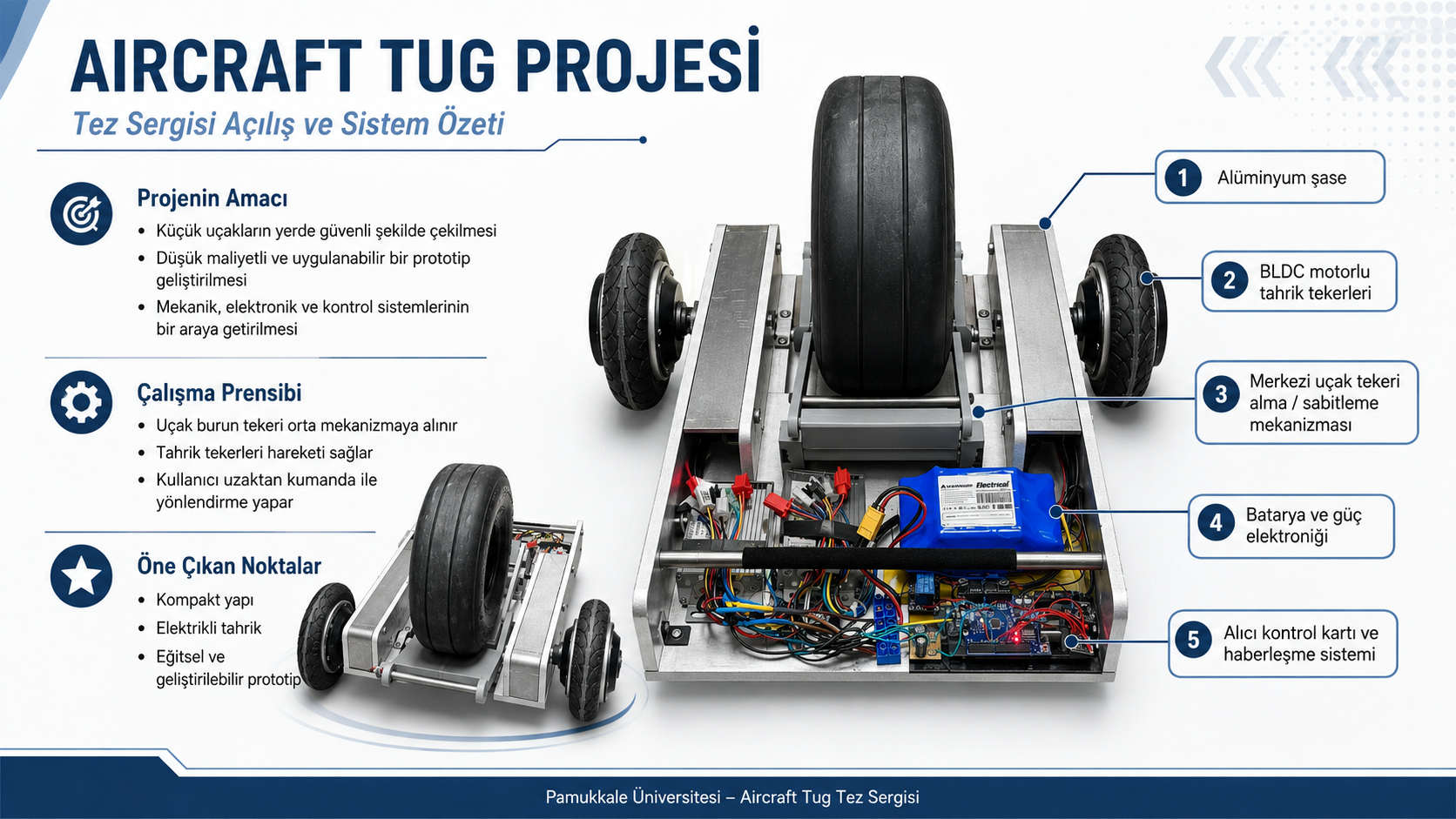
Bu proje nedir?
Uçaklar park halindeyken bir noktadan diğerine taşınması gerekir: hangara çekmek, park yerine yanaştırmak ya da bakım alanına almak gibi. Bunu uçağın kendi jet/pervane motorlarıyla yapmak hem tehlikeli hem de israftır. İşte bu noktada uçak çekici (aircraft tug) devreye girer — uçağı yerde iten/çeken özel bir yer destek aracıdır.
Benim projem, hafif uçaklar için tasarlanmış, elektrikli ve uzaktan kumandalı bir çekici. Operatör güvenli bir mesafeden kumanda ile aracı yönlendiriyor; araç da uçağı yavaş ve kontrollü biçimde hareket ettiriyor. Amaç; gerçek dünyada karşılığı olan, çalışan bir sistem ortaya koymaktı.
What is it?
Parked aircraft often need to be moved from one spot to another — towed into a hangar, lined up at a stand, or taken to a maintenance bay. Doing this with the aircraft's own jet/propeller engines is both dangerous and wasteful. This is exactly where an aircraft tug comes in — a piece of ground support equipment that pushes or pulls the aircraft on the ground.
My project is an electric, remote-controlled tug designed for light aircraft. The operator steers the vehicle with a handheld controller from a safe distance, and the vehicle moves the aircraft slowly and under control. The goal was to build a real, working system with genuine real-world value.
Nasıl çalışır?
Sistem dört temel adımda çalışır. Önce kumanda, operatörün gaz ve yön komutlarını 2.4 GHz bandında nRF24L01 kablosuz modülüyle gönderir. Araçtaki STM32 denetleyici bu komutları alır, güvenli sınırlara göre yorumlar ve motor sürücüye uygun sinyalleri üretir.
Motor sürücü, fırçasız doğru akım (BLDC) motorunu doğru sırayla enerjilendirir; tekerlekler de uçağı hareket ettirecek tahrik kuvvetini üretir. Tekerlek hızının geri beslemesi denetleyiciye geri döner, böylece araç ani sıçramalar yapmadan yumuşak ve kontrollü ilerler. Bu “komut → işle → sür → geri besle” döngüsü saniyede birçok kez tekrarlanır.
How it works
The system runs in four core steps. First, the remote sends the operator's throttle and steering commands over the 2.4 GHz band using an nRF24L01 wireless module. The STM32 controller on the vehicle receives those commands, interprets them against safe limits, and produces the right signals for the motor driver.
The driver energizes the brushless DC (BLDC) motor in the correct sequence, and the wheels produce the traction needed to move the aircraft. Wheel-speed feedback returns to the controller, so the vehicle advances smoothly and under control instead of jumping. This “command → process → drive → feed back” loop repeats many times per second.
Neden elektrikli ve uzaktan kumandalı?
Klasik dizel çekicilerin aksine elektrikli çekiciler egzoz gazı çıkarmaz; bu sayede hangar gibi kapalı alanlarda bile rahatça kullanılabilirler. Elektrik motoru düşük hızda bile yüksek ve hassas tork verdiği için uçak gibi değerli ve ağır bir yükü milimetrik kontrolle hareket ettirmek mümkün olur.
Uzaktan kumanda ise operatörün aracın etrafını net görebileceği bir noktadan çalışmasına imkân tanır. Bu da hem güvenliği artırır hem de tek kişinin operasyonu yönetebilmesini sağlar. Kısacası: daha temiz, daha sessiz, daha kontrollü ve daha güvenli bir çözüm.
Why electric and remote-controlled?
Unlike classic diesel tugs, electric tugs produce no exhaust fumes, so they can be used comfortably even in enclosed spaces like hangars. Because an electric motor delivers high, precise torque even at low speed, it becomes possible to move a heavy, valuable load like an aircraft with millimetre-level control.
Remote control lets the operator work from a spot with a clear view all around the vehicle. That improves safety and allows a single person to run the operation. In short: a cleaner, quieter, more controlled and safer solution.
Üzerinde çalıştıklarım
- Motor & sürücü: BLDC motorun ve sürücü katının seçimi, gerçek yük altında kontrol ve güvenlik senaryolarının geliştirilmesi.
- Kontrol yazılımı: STM32 üzerinde komut yorumlama, yumuşak hızlanma/yavaşlama ve sınır koruma mantığı.
- Kablosuz bağlantı: nRF24L01 ile düşük gecikmeli, güvenilir komut iletimi.
- Mekanik tasarım: CAD ile şasi ve kavrama mekanizması tasarımı, 3D baskı ile prototipleme.
- Sistem entegrasyonu & test: Donanım, yazılım ve mekaniğin bir araya getirilip gerçek koşullarda denenmesi.
What I worked on
- Motor & driver: selecting the BLDC motor and driver stage, developing control and safety scenarios under real load.
- Control software: command interpretation on the STM32, smooth acceleration/deceleration and limit-protection logic.
- Wireless link: low-latency, reliable command transfer over nRF24L01.
- Mechanical design: chassis and gripping mechanism in CAD, prototyped with 3D printing.
- System integration & testing: bringing hardware, software and mechanics together and trying them in real conditions.
Kullanılan teknolojiler
Technologies used
- STM32
- BLDC motor
- nRF24L01 (2.4 GHz)
- PWM
- Embedded C
- CAD
- 3D Printing